






 Copy Link
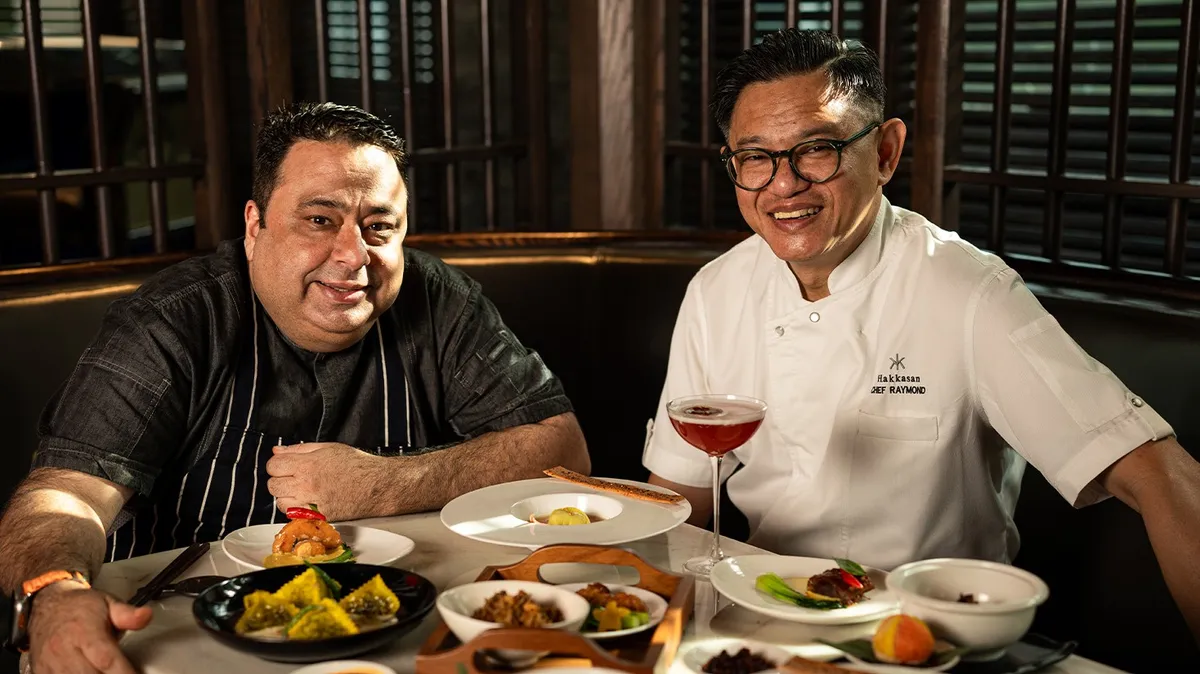
On the Silk Route, India exchanged spices, fruits and vegetables with China for rice, silk and pottery. Last week, Hakkasan Mumbai hosted a seven-course sit down menu Silk and Spice over three days showcasing the Yin and Yang mastery of chefs Manish Mehrotra and the restaurant’s executive chef Chef Raymond Wong.
_1754375442563.jpg?w=800&f=webp&t=c3644254e32d5409)
Each took a unique approach on the Route. While Mehrotra rekindled his pan-Asian roots tracing back to the start of his career at Thai Pavilion; Chef Wong crafted modern Cantonese preparations.
_1754375503074.jpg?w=800&f=webp&t=891b8a64668c04e3)
Cantonese sphere packed with crisp black rice to Himalayan Soupy Dumpling paying homage to the Jhol Momo with its Tibetan origin and a Nepali broth. The duel took turns between an Emperor’s saffron soup broth to butternut squash with spicy basil in a coconut and pickled puddle. The ending, pitted Mehrotra’s XO butter rice with Wong’s silkiest truffle sauce accentuating morels and lamb shank in an elegant closure.
%20-%20Hakkasan%20Mumbai%2007193%20(1)_1754375524613.jpg?w=800&f=webp&t=4107887673322e47)
A day before the big weekend, we catch up with the duo. A year since Mehrotra hung his apron after running Indian Accent for 15 years, the 51-year-old flaunts a leaner look. “I have been taking care of myself” he tells us. “This is the first time I am cooking pan-Asian in public, that too without a team!” Mehrotra has lightened up. He is a one-man army without a team or prebatched ingredients.
A jovial Wong joins us over tea, cracking inside jokes that show their camaraderie. “I have to co-operate with a big celebrity chef,” to which Mehrotra says, “Let me tell you, Wong took the dibs on all the expensive ingredients!”
_1754375617443.jpg?w=800&f=webp&t=b6dba65693507fd3)
Mehrotra sets the record straight: “We are very similar in the way we function in the kitchen. We both don’t use tweezers, nor do we have tattoos like the young chefs today!” Mehrotra chimes in. While Mehrotra’s dishes are a leaf out of Thai cuisine, they traverse around the region. He also flexes his Indian cooking prowess. One standout example is Jhol momos. “Tibet made momos and Nepal added jhol. But today, you get more momos in Delhi's Lajpat Nagar than in Nepal. They even made a tandoori version out of it,” says Mehrotra. On the menu, they are Himalayan soupy dumplings without fuss but with a finesse that narrates a warm story of the hills.
On the cooking style, Wong explains, “The menu showcases how the cuisines have modernised by adopting different ingredients and techniques. Before the year 2000, Chinese cuisine was very traditional. It opened up to the world with the Internet boom. Truffle, morel, edamame – we didn’t use them until then. We found ourselves in the new age, with an open mind. The world had so much to offer. We made our dishes artsy, colourful, using complex techniques. However, it was not possible, for one chef to spend 20 mins on a dish. Who is going to run the restaurant, then?” he laughs.
_1754375702544.jpg?w=800&f=webp&t=a7a1047403ba476b)
Modern Cantonese makes room for new ingredients and cuisine update. “A traditional Chinese fragrant chilli sauce or the Dragon sauce easily fits in a Japanese rice. Call it evolution of the cuisine. One has to move with the times; the world has become smaller,” says Wong,” adding, that techniques are introduced mindfully. “If we use smoke, we would use tea or Sichuan pepper.
Mehrotra draws an Indian parallel. “Smoking dishes or dhungar is an age-old technique across India. Puri in Orissa even has smoked chaas. On the other hand, Indians are open to consuming raw fish. Twenty years ago, that was unheard of!” says Mehrotra.
Team spirit
The three-day pop-up has also opened a gateway for the chefs to learn from Mehrotra. “We have our own ways, but it is nice to learn from outside. The team was curious to know how the chef will treat the pumpkin and make the lamb shank,” says Wong.
Sharing an anecdote, Mehrotra shares, “A cook was cutting Jicama, a North American root vegetable. I asked the team if India has a variety? No one realised it is similar to a misrikand, commonly grown and consumed in Bihar. During Saraswati puja and Holi, we offer it to the gods. Now, they will never forget it.”
In a relaxed state of mind
While everyone is waiting with baited breath to witness his next big move, Mehrotra is playing it cool. “I have relaxed my pace, using my time to travel and teach. I’m in a phase where I am not thinking about the day-to-day running of a restaurant, or menus or catering to customers. I am obsessed with Pinterest. I have a collection of canape board inspirations that I want a carpenter to create for me,” he says.
On food and cocktails trends, Mehrotra recognises that innovation is at its peak. “I feel like in the last year, I have gained a bird’s eye view during my so called ‘break’. In a time where everyone is trying to innovate, ideas should go back to the basics, for it solidifies the ground for balancing taste. “Begin with a fresh lime soda, before you join the 2.0 bandwagon,” he signs out.
Dishes from the special menu are available as ala carte selections for a month.