






 Copy Link
Snapshots
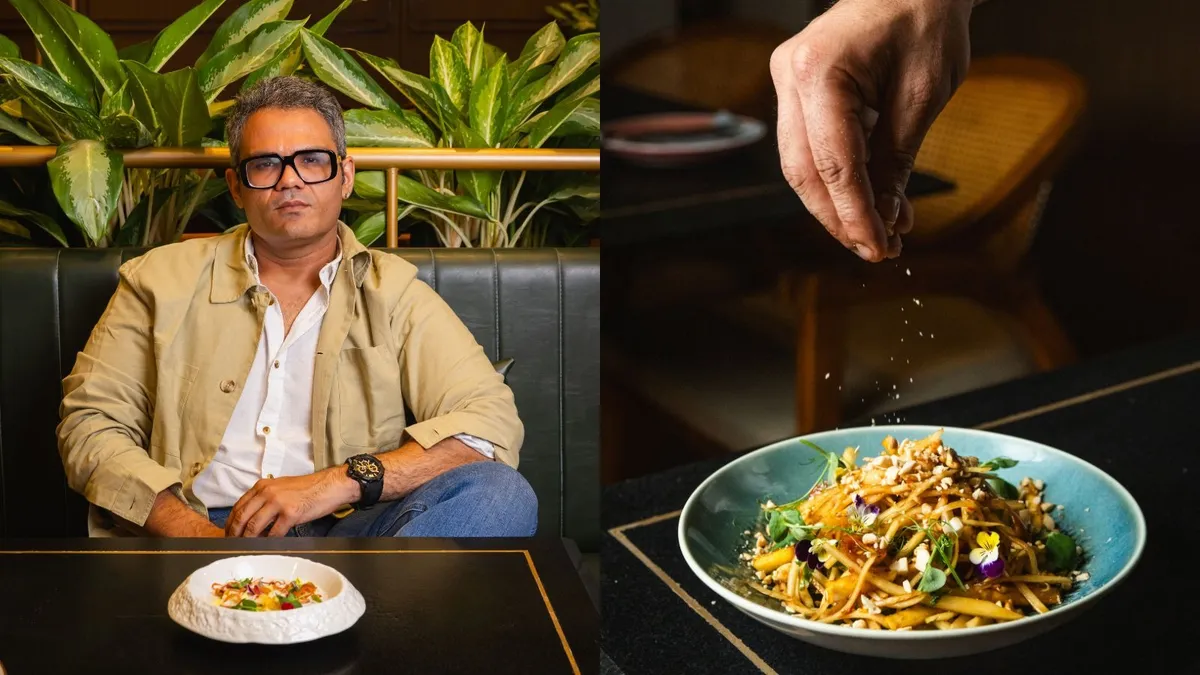
Chef Tarun Sibal doesn't believe in repeating himself. Whether it's the dishes on his ever-evolving menu or the spaces he creates and recreates, each project is a carefully orchestrated story. Part chef, part entrepreneur, all storyteller. In conversation with us, he unpacks how Street Storyss became Bangalore's most distinctive vegetarian restaurant, why the Tapori pop-up in Bangkok was just the beginning, and why taste will always trump the Instagram moment.
What was the genesis behind Street Storyss?
We were all in Bangkok, eating at one of the roadside eateries. Akshay and I, when we eat, we order the entire menu. We ask for everything that somebody is selling. That's how we eat. We were having morning glory, and that's when the thought came in—why can't we do something in Bangalore, which is global street food? My take on it. Let's do this vegetarian because there was a story to tell. There was a narrative that we could share with the Bangalore audience. Global street food with my take on it, with this concept of "gourmet casual"—extremely gourmet, but non-pretentious. That's how Street Storyss was born. In 2019, we opened in Indiranagar. I still remember the first weekend—we were a packed house.
We got a lot of love. And then COVID struck. While everybody else was shutting down, we added 60 to 70 more seats to the 40-seater that we had. That was the love we got from Street Storyss from the very word go. It gave us the hunger to do more. In the last five years, we've evolved Street Storyss into the most prominent, probably the first craft kitchen vegetarian place in Bangalore.
You're both a chef and an entrepreneur. How do you balance those two roles?
It always starts as a storyteller. It always starts with the product. It always starts with, I want to do this. There's this kid-like energy that I get excited about. Once I've shelled out the product—this is what I want to do, this is the broad narrative that I want to showcase—that's when the same file goes back to me as a financier. Okay, can this make money? Will this be scalable? Can I make numbers for each and every one who's a part of this project?
I play myself the devil's advocate. Sometimes the chef gets a kick on his backside, and sometimes the entrepreneur gets the kick. So it's an intermingled process, but it always starts as the architect. I always start as the architect, and then the numbers come in. Artist first, and then the entrepreneur.
There have been options where you look at a location, and the entrepreneur says, I don't want to lose out on this location. I will do anything in this location. So it's the other way around also. But for me personally, when I have an idea, it starts with an idea. I flesh it out, and then I think, where can I put this? What is the ideal market for it? Where should the second option be? That's the process. You think of a product first. You think of a brand first. You think of a story first, and then post that, you look at numbers and how you can actually conceive this and make it into a brick-and-mortar model.
How did you approach the collaboration with Tapori, given that Street Storyss is street food with a gourmet lens, and Tapori operates in a different space altogether?
It was a completely new menu. It all started last year when we won Best Vegetarian Restaurant of the Country three years in a row, and I wanted to do a celebratory tour. I wanted to showcase what we do on a vegetarian front for a global audience. Tapori had the kind of credibility it had in Bangkok—it wasn't your typical Indian restaurant. It had a lot of meat, a lot of pedigree. Rohit is a great chef. I know him from the past. He's a friend. It just became so easy to pick Tapori to do this.
Did it feel like a natural expansion, given that the vegetarian fair is Street Storyss' identity?
It was very simple. He was doing his bit. I was doing my bit. We plugged that together in a pop-up menu where he was doing the non-vegetarian affair, and I was doing the vegetarian affair. It's always been like that with me. I've done this multiple times. Even with non-vegetarian food on the table, I get the underdog feeling, and you always come up aces because you have an audience that's looking at it. The non-vegetarian affair looks and feels kind of dominant, but when it's on the table, the vegetarian plates are at par or, if not better. That's how we surprise our audiences.
Tell us about some of the standout dishes from the Tapori pop-up.
_1775974913310.jpg?w=800&f=webp&t=5b582dbf690db0c0)
I started with an amuse-bouche—an artichoke carpaccio with gulgul and a mint dressing. For a mousse, anybody who took that first bite was done and ready for the entire meal because it set the bar so high with the first bite. They were now expecting an extremely awesome vegetarian affair.
There's one dish I'm particularly proud of—I did a take on khichdi. I did a moringa leaf and green lentil risotto with a carrot achari milk. You know what? Everybody sitting at the table was a carnivore. When this course came in, and the achari milk dropped into a moong dal risotto with moringa, people went bonkers. That was almost like the most talked about dish on the entire table.
We also had a mushroom sukka gyoza with a tomato chutney. I did a jackfruit sukka with a Japanese sushi house sauce, topped with a mango cashew salad, coming with a parotta. There were a lot of interesting takes on various cuisines, on street food. Two different styles, two different preps, two different techniques. A lot of jugalbandi was happening. But this risotto, particularly, was not something many people were expecting much out of, but it became their favourite plate on that table that night.
How did you curate the menu? What was the process?
_1775974499953.jpg?w=800&f=webp&t=7aca3384739972c1)
We always knew we were doing a fresh menu. The first time we were trying for this pop-up, the dates were during Lohri. We wanted to do a festive Lohri menu. But Thailand was still mourning, so that got delayed. I had a Lohri menu planned, and then we said, this is not happening on the 13th of Jan. Let's look at a spring menu. That's during Holi time, so we'll go there. I did a new menu which was absolutely based on colour, on keeping stuff light on the palate. In Hindi, we call it "taasir"—a visual treat and something that nourishes.
Rohit and I went back and forth on making sure that though our dishes individually are scoring well, they also score well as a cohesive menu. If I'm eating non-vegetarian as well as vegetarian for a single course, then it should make sense. A lot of dishes were tweaked to ensure that I wanted this to showcase in my menu, Rohit in his menu, and all of that became one story, one narrative, one tune.
You mentioned reinvention. Is that something you apply to all your spaces?
Every part of the restaurant, every part of a single project, should tell you the same story. Titlie started as a beach cliff bar—say, like India's Cape del Mar six years ago. Last year, we shut the place down, brought it to the ground, and completely changed what it would feel like now. We kept the same soul, but we changed everything around it because we were getting jaded. It was six years. The audience has changed. The way people consume a particular location is a big part of how you move forward.
We keep reinventing both in terms of product in totality—not just the menu. The way it looks, the way it feels. My service standards have gone up. The consumer profile has changed, or the same consumer is now way more aware. The competition has increased. There are so many people doing so much good work. As a chef, you need to make sure that you're aware of what's happening around you. People are well versed. They're well-travelled.
Was the Tapori pop-up a testing ground for international expansion?
Yeah, I think global street food and the brand Street Storyss could fit very well in a market like Bangkok, Dubai or even the Philippines. We're looking at Bombay. We're looking at other cities. So this was also not a test—we already knew that we're going to be extremely loved when we do this. But it's always nice to be there and see it for yourself. Everything else is just ruminating. But once you're there and you see the reaction right in front of you, you substantiate your gut.
What culinary conversations have caught your attention in the past three months?
This one thing that keeps coming back every six months is, you know, you go back to taste. I mean, everything else is a lot of fluff. Street food is also like that. When we look at Street Storyss, the best food is available on the street because the guy who's doing it can also do it in his sleep. He's been doing a single dish for the past 20 years. He can't go wrong.
In the past few months, past few years, every six months, we have the same conversation: taste forward, palate forward. That's what food should do. A plate of food should nourish you, should feel like, "wow, oh my God, this is amazing." Everything else becomes kind of an ancillary thing. The way it looks—I mean, what's the point of a great-looking dish if you can't go back to it? It always starts with taste.
I've been a protagonist of this concept. It needs to look nice, but it needs to taste better. Every time somebody says to me, "Oh, this looks awesome," I say it tastes better. Every time I put a story on Instagram and somebody says, "Oh, chef, this looks really, really awesome," my standard line is, you know, it looks awesome. It tastes actually better than how it looks. That's how I think when I cook.
In popular perception, street food and Michelin-star restaurants are very different worlds. Are you looking at blurring those lines?
_1775974717823.jpg?w=800&f=webp&t=8fbc46b941149ef6)
Let's look at various top Indian restaurants and non-Indian restaurants. Everybody has a chaat on their menu. Three-Michelin-star restaurants have chaats on their menu. That is street food, right? They've taken something and elevated it.
I do not touch things that I can't improve. I don't want to take something for the heck of it because it's street food and can't elevate it. What's the joy of it? A golgappa should first take care of your golgappa craving and then give you more. If I can't even get you the golgappa craving right, then what's the point of putting it on the menu?
Classic example—we have a pizza dough bhature chole on the Street Storyss menu. Bhature chole is a staple from where I come from. In Delhi, that's our Sunday breakfast every Sunday. So when we put that on the menu, I said, how can I take the humble bhature chole, which everybody is so anal about—that this is the best one—how can I stop that debate and make something my own? I used pizza dough for the bhature. It's a completely different experience. I did not change the chole at all. I kept it as Delhi as possible. But with the bhature, I spread my wings and said, let me do this. And it became one of our top sellers today.
Street food and gourmet and so-called finesse can go together. It's not two different things. It can be clubbed.
What do you wish every diner understood better about vegetarian fare?
Indians' eating out behaviour is very distinctive from that of any other community. What we eat at home, vegetarian or non-vegetarian, and what we eat outside are at times two different things.
Then the treatment of vegetarian cuisine needs an upgrade. It's already going there. How vegetarian khana could be lip-smacking, could be extremely palatable on the eye, and give you a feeling that, okay, you've actually dined out, paid for something, and you've got your value's work. Indians love to pay when it can't be done at home. You don't want to listen to "I can make this at home", or "My mom makes this better." So how do you elevate that experience?
How do you go about the pre-production part when developing new concepts?
In terms of new concepts, I have the knack of substantiating my gut. I travel a lot. I eat out a lot. I get inspired a lot. I love doing two plus two five. And whenever I've thought that two plus two is five, it has been five and a half. So I'm kind of blessed. Someone asked me, "How can you create so many different menus without repeating yourself?" I said, it just comes to me. It's not something that I have to struggle with. It just comes to me.
I spend time on my laptop thinking about new dishes. And in the kitchen, it'll take me 15 minutes. Once you have that concept ready, before you open it, it's your entire team—your social media team, your PR team, you yourself—then become a mouthpiece to ensure that it gets that opening that it deserves.
I don't cook for myself. I cook for people. Once you've done that plate, your job kind of finishes once you've presented it on the table. And then you want the world to see. You want the world to take that first bite, and that reaction on their face makes you sleep happy.
You've mentioned approaching food like a filmmaker. Can you elaborate?
_1775975055439.jpg?w=800&f=webp&t=b636aa94d2f83e4b)
I don't repeat a single dish across my restaurants because each is like a filmmaker doing a thriller and then doing a rom-com. He's not going to repeat what he's doing in a thriller in his rom-com, right? So I look at food with that lens. I look at restaurants and the F&B industry with that lens, wherein each project of yours or each offering of yours should be extremely viable in its own mood board, in its own format, and there's a purpose that you're doing this. You can't change the story. The story should be extremely unique.
A good restaurant needs everything. A very bound script. It needs post-production marketing for that Friday launch. But it also needs an item number in terms of a dish. It needs a great star cast. It needs the right star cast. It needs music production. It needs everything to make it work. But it all starts from a great tight script.
This interview has been edited for clarity and length.